
Menu
Flatwork Joints, Control Cuts & Cracking Prevention in Paterson
Concrete Flatwork Paterson
A well-planned strategy for the location and spacing of joints, control cuts, and how cracks are prevented is an important part of installing durable concrete flatwork in Paterson, with its unique environmental challenges. The methods listed above will help direct concrete’s natural tendency to develop cracks as a result of drying shrinkage, thermal expansion/contraction, and settlement stresses. Contractors who do this work know that by controlling when and where the random cracking occurs, they can protect the structural integrity of the driveway or sidewalk and/or patio and commercial surface; this is especially important in Paterson since there are many projects located close to the Great Falls Historic District, as well as those in the vicinity of Eastside Park. It is very important to consider the specific types of soils and weather that exist in Paterson before attempting to install new flatwork, and it is equally important to properly design and install your joints so that you avoid future expensive repair costs and maintain your property value.
Understanding Concrete Flatwork Basics
Flatwork refers to all horizontal concrete surfaces (driveways, sidewalks, patios, garage floors, commercial slabs). To accommodate the natural concrete shrinking (and expanding) process, while creating a firm, even surface for users, proper design of flatwork is important in determining the amount of load (weight) it will support, as well as how it drains (water flow), and what environmental effects (freeze-thaw, temperature changes, etc.) will influence the surface. As concrete cures, internal stresses form, which are released through controlled joints and cuts. If the contractor properly executes the installation process, this will cause the concrete to move in predetermined areas (joint locations)rather than randomly cracking.
Environmental Effects in Paterson, NJ
NJ has many freeze-thaw cycles (temperature extremes) throughout the winter months, causing a great deal of stress to concrete surfaces. Changes in temperatures cause concrete to expand and contract, therefore, requiring flexible joint systems designed to accommodate the movement. Seasonal variations in moisture affect the stability of the soil under the concrete slabs and, ultimately, the settling pattern. Because Paterson is located near the Passaic River Valley, local soil conditions must be taken into consideration when preparing the base for concrete slabs to provide adequate drainage and base preparation. Contractors should have experience in adapting their techniques to address regional issues.
Types of Concrete Joints
There are four main types of concrete joints:
- Construction joints – Separate concrete pours to allow for planned work interruptions during large projects.
- Control joints (also known as contraction joints) – Create intentional weak points in the concrete to allow it to crack in straight, controlled lines.
- Expansion joints – Designed to accommodate thermal movement (heat-related expansion and contraction), they help to prevent buckling during extreme heat conditions.
- Isolation joints – Help to prevent stress transfer between concrete slabs and adjacent structures (buildings, utilities, etc.).
Design Principles for Control Joints
The spacing of control joints should be determined by the slab thickness, as follows:
- For example, 4 inches of concrete would require a joint every 8-12 feet to effectively prevent random cracking.
- Panel shapes should be as square as possible to evenly distribute the stresses to the entire panel.
- Re-entrant corners cause stress concentrations that will either require a specialized joint placement or reinforcement to prevent cracking.
- Professional planners of flatwork installations take into account the above factors, as well as aesthetics and functionality.
Applications for Isolation Joints
Isolation joints provide a separation between new concrete and existing structures to prevent stress transfer during movement. These joints typically utilize a compressible fill material to accommodate differential settlement and thermal expansion. Adequately installed isolation joints prevent cracks from developing at intersections between driveways and garage slabs, or sidewalks and building foundations. The material used in the joint must be weather-resistant and retain its compressible properties over time. Professionally installed isolation joints will completely separate the new concrete from the existing structure while maintaining a continuous surface.
Timing for Saw Cutting
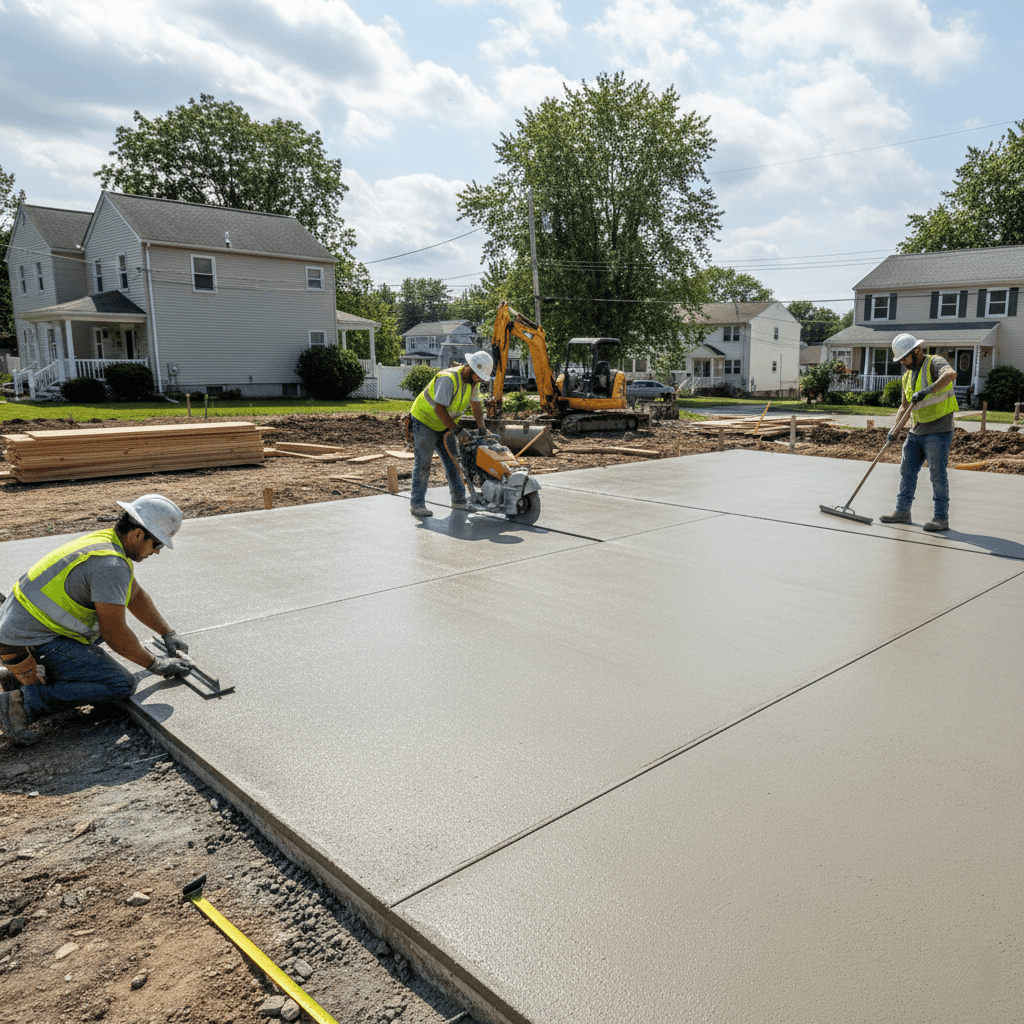
Saw cutting is utilized to create precise control joints once the concrete has reached a suitable strength to prevent raveling (removal of surface layer). Early-entry dry-cut saws can begin operating anywhere from 1-4 hours after finishing, whereas traditional wet saws require 4-12 hours after finishing, depending on the concrete temperature, ambient conditions, and mix design characteristics. Acutely timed cutting ensures that the cuts are made at the correct time to create a viable weak point, typically 25% of the slab thickness. Professionally executed timing ensures that neither surface tearing nor random cracking results from delayed cuts.
Minimum Depth Requirements for Saw Cuts
Standard concrete slabs require a minimum of 1/4 of the slab thickness to activate the joint. Fiber-reinforced concrete may require deeper cuts to compensate for the increased tensile strength due to the addition of fibers. Regardless of slab thickness, the minimum depth of a cut should be 1 inch to establish a viable weak point. Deeper cuts (up to 1/3 of the slab thickness) may be required in thicker slabs to guarantee proper crack development. Professionally installed concrete contractors will adjust cut depths based on specific mix designs and reinforcement configurations.
Factors to Consider Regarding Weather
Hot weather accelerates the setting of concrete and may limit the time available for saw cutting to 6 hours or less to prevent random cracking. Cold weather slows down the setting process and may extend the window for saw cutting, but will require close monitoring. Wind and low humidity will increase the rate of surface drying and may necessitate earlier scheduling of saw cutting. Paterson’s unpredictable weather conditions demand that contractors adapt their saw-cutting schedules to reflect the current weather conditions. Professionally executed monitoring ensures that optimal cutting schedules are maintained regardless of the weather.
Strategies to Prevent Cracking
Preparing a stable subgrade will prevent settlement cracking from occurring under concrete slabs. Properly compacted base materials will distribute loads evenly and provide consistent support for concrete slabs during freeze-thaw cycles. Vapor barriers will prevent moisture from migrating upward through the subgrade and into the concrete, thus preventing curling and differential shrinkage stresses. Placing reinforcement in the concrete will help to regulate the width of cracks when movement occurs. Professionally prepared bases address all potential sources of premature cracking.
Preparation of Subgrade and Base Materials
All organic materials, debris, and unsuitable soils must be removed before excavation. Proper compaction will achieve 95% of maximum density and will provide a stable base for concrete loads. Granular base materials will provide drainage and distribute loads over weak subgrade soils. Uniformity in thickness will provide consistent support across the entire slab. Professionally prepared bases will eliminate differential settlement and subsequent structural cracking.
Considerations for Mix Designs
Reducing water-cement ratios will decrease shrinkage potential, but require proper workability for the placing and finishing operations. Using fiber reinforcement will help control the width of cracks and prevent surface plastic shrinkage cracking. Admixtures can alter the setting time, workability, and shrinkage characteristics of the concrete to accommodate specific applications. The grading of aggregates will determine the workability, finishability, and durability of the finished surface. Professionally developed mix designs balance all of the above considerations to optimize performance.
Installation Techniques for Longevity
Installing concrete to eliminate air voids will produce a uniformly dense slab thickness. Screeding and floating will produce a level surface that embeds aggregate particles below the surface. The timing of finishing operations will impact the quality of the surface and the ultimate durability characteristics. Over-finish will produce surface layers that are weak and prone to scaling and dusting. Professionally executing the finishing processes will help you understand the timing requirements for each operation.
Finishing and Surface Preparation
Immediately after screeding, bull float the surface to eliminate surface defects and prepare the surface for further finishing operations. Hand-floating with wood or metal floats will produce a smooth, dense surface, ready for final texturing. Timely completion of finishing operations will ensure the surface is properly moistened for effective finishing. Surface texture will provide slip-resistance and maintainability for a variety of applications. Professionally completing the finishing processes will produce a durable surface resistant to weathering.
Managing the Curing Process
Maintaining the surface moisture and temperature will optimize the strength gain and durability of the concrete. Curing compounds, wet coverings, or plastic sheeting will prevent premature moisture loss during the critical early ages of the concrete. Extended curing periods will improve the long-term durability and resistance to freeze-thaw damage. Temperature control during the curing process will impact the final strength and surface quality of the concrete. Professionally managing the curing process will maximize performance from the mix design.
Joint Sealing and Maintenance
Sealers will prevent water and debris infiltration that will damage and degrade the joints over time. Flexible sealants will accommodate joint movement while maintaining a weather-tight seal throughout seasonal cycles. Proper preparation will include cleaning out any loose material and ensuring proper bonding between the sealer and the concrete surface. Selection of a sealer will depend upon the joint size, expected movement, and exposure conditions. Professionally installing sealers will extend the life of the joints and maintain surface performance.
Criteria for Selecting Sealers
- Silicone sealers – Provide good weather resistance; however, they may have limited adhesion in certain applications.
- Polyurethane sealers – Will provide superior flexibility and adhesion for joints experiencing high degrees of movement.
- Rubberized hot-pour sealers – Work well for large joints in commercial applications with heavy traffic.
- Color options for sealers – Include clear, gray, and various colors to match or contrast with the color of the concrete surface.
- Professionally selecting a sealer will ensure that it will perform as desired under the specified conditions.
Maintenance Scheduling
- Annual inspections will identify deterioration of sealers, cracking, or loss of adhesion prior to major problems developing.
- Cleaning will remove debris and deteriorated sealer material prior to reapplying new sealer material.
- Reapplication of sealers will vary depending on the type of sealer selected, degree of traffic, and exposure conditions.
- Preventive maintenance costs far less than repairing damage resulting from failed joint seals.
- Professionally implementing preventative maintenance programs will ensure the longevity of flatwork investments and minimize costly repairs.
Common Installation Errors
Failure to adequately space joints will allow random cracking to occur between planned control joints throughout the installation. Shallow cuts will fail to create an effective weak point and create random cracking patterns. Poor timing of joint installation will result in surface tearing or ineffective crack control. Failure to properly prepare the base will result in settlement cracking that will bypass control joints. Professionally trained and experienced concrete contractors will avoid the aforementioned installation errors through proper planning and execution.
Identifying and Troubleshooting Crack Issues
Random cracks between joints will indicate that joints were spaced too far apart, or that cuts were too shallow for the specific conditions. Cracks that do not follow the joint lines will indicate that there was a problem with the joint layout or timing of the installation. Settlement cracks will appear as step cracks and will typically follow an irregular pattern across the surface. Surface crazing will indicate that there were problems with the finishing process or curing procedures during the installation process. Professionally diagnosing the source of the crack issue will enable the contractor to implement the most cost-effective repair strategy for the specific situation.
Options for Repair and Restoration
Injecting cracks with polyurethane or epoxy will restore structural integrity and prevent water from entering the cracks. Applying a surface overlay will camouflage cosmetic cracks and provide a renewed surface performance and appearance. Re-cutting joints may be necessary if the initial cuts were too shallow to be effective. Replacing the entire installation will become necessary if the structural damage compromises the entire installation’s integrity. Professionally evaluating the extent of the damage will enable the contractor to recommend the most cost-effective repair option for the specific situation.
Inspection and Quality Control
Pre-installation planning will review subgrade conditions, drainage requirements, and environmental conditions that will affect the project. During installation, monitoring will ensure that the contractor is meeting the proper timing requirements for all critical operations (i.e., joint cutting, surface finishing, etc.). Post-installation inspection will confirm whether the joints have activated and the surface quality meets acceptable standards before final acceptance. Documentation will provide historical records for future maintenance and warranty coverage for the entire service life of the installation. Professionally executed inspection and quality control will prevent problems and ensure long-term performance.
Testing and Verification
Testing the compaction of the subgrade will ensure that the subgrade and base materials have been properly prepared before placing the concrete. Slump testing will ensure that the concrete has adequate workability during the placing and finishing operations. Monitoring the temperature of the concrete will guide the curing procedures and joint cutting timing decisions during the critical periods. Measuring the depth of the joints will verify that the joints were sufficiently deep to provide effective crack control. Professionally performing the testing will provide the contractor with objective confirmation that the quality of the installation has met the acceptable standards. Expertly installing and maintaining concrete flatwork will ensure that it performs optimally throughout Paterson’s harsh climate conditions.
Paterson Concrete Works understands the critical importance of proper joint design, timely control cuts, and effective crack prevention strategies that protect your investment for decades of reliable service.
LATEST POSTS